ICY BOX IB-HUB1743-CPD Review: 9-in-1 USB Hub with PD and LED Power Meter
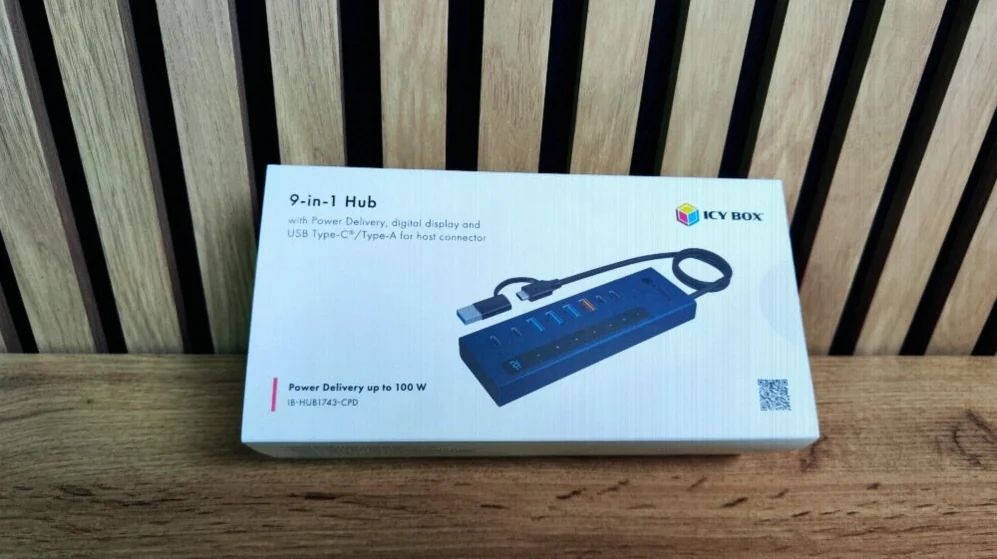
ICY BOX has launched the IB-HUB1743-CPD, a desktop-focused USB hub built to solve a very specific pain point: modern laptops and PCs often don’t have enough USB ports for a full setup. Instead of trying to replace a full dock, it concentrates on expanding USB connectivity, adding charging support via Power Delivery, and keeping the status of power draw easy to verify—using a built-in LED display.
Release details and what’s included
| Model | Article number | EAN | Color | In the box |
|---|---|---|---|---|
| ICY BOX IB-HUB1743-CPD | 61158 | 4250078174929 | Blue | Hub, 12V / 4A power adapter, instruction manual |
The IB-HUB1743-CPD is positioned as a “USB center” for desks rather than a travel adapter. It ships with its own external power supply (12 V / 4 A), which is key for stability when multiple devices are connected and charging is involved. The unit also uses passive cooling.
A 9-in-1 hub that prioritizes USB—not video or networking
This hub is deliberately not a traditional docking station. It does not provide HDMI, DisplayPort, Ethernet (RJ-45), or any SD/microSD card reader. There’s also no audio jack or M.2 storage slot. The design goal is to give you more USB ports in one place so you can stop constantly swapping cables at your workstation.
That makes it a strong match for typical multi-device setups: a mouse and keyboard, a USB microphone, USB flash drives, an external SSD, a USB capture device, a phone charging cable, controller accessories, and similar peripherals. The manufacturer also includes a dedicated USB-C PD charging port for a secondary device.
Host connectivity and data transfer limits
For connecting to your computer, the IB-HUB1743-CPD uses a host interface of USB 3.2 Gen 2 Type-C. The hub includes a built-in host cable with a hybrid USB-C/USB-A connection and a length of 60 cm, allowing it to work with both USB-C and older USB-A PCs without an extra adapter.
In terms of throughput, the hub supports up to 10 Gbit/s on its fastest ports and up to 5 Gbit/s on the remaining connections. The maximum transfer rate to the host is capped at 10 Gbit/s, meaning all devices share the upstream bandwidth. It supports UASP and Plug & Play, with HotSwap available for connected peripherals.
Port lineup: what you get
The hub provides a total of nine USB-related connections, split across USB standards to match real-world usage—fast ports for storage and high-bandwidth peripherals, and slower ports for accessories that don’t need maximum throughput.
- 2 × USB 3.2 Gen 2 Type-C (up to 10 Gbit/s)
- 1 × USB 3.2 Gen 2 Type-A (up to 10 Gbit/s)
- 3 × USB 3.2 Gen 1 Type-A (up to 5 Gbit/s)
- 1 × USB 3.2 Gen 1 Type-C (up to 5 Gbit/s)
- 1 × USB-C Power Delivery port (up to 20 W)
Power Delivery up to 100 W for the host device
The headline charging feature is Power Delivery for the host: the hub supports up to 100 W upstream Power Delivery, allowing it to charge compatible laptops via the USB-C uplink. There’s also a separate USB-C PD charging port rated at up to 20 W for powering an additional device such as a phone, headset, controller, or other small accessory.
To make the hub practical for desk use with many peripherals, it includes its own 12 V / 4 A power adapter rather than relying entirely on the host laptop’s power budget. A built-in LED display shows Power Delivery charging status, and the unit includes LED indicators for power and access, aiming to make it clearer when charging is active and what’s happening with power delivery.
Design for a stable desk setup
The IB-HUB1743-CPD uses an aluminum enclosure in blue and is built to sit firmly on a desk. It’s slim and low-profile, with a longer body designed not to “wobble” as you plug in and remove drives.
There’s also an ON/OFF button on the hub, allowing you to disconnect it without pulling the adapter from the wall.
Who it’s for—and what to expect as a limitation
The IB-HUB1743-CPD is designed for people who want more USB ports while keeping everything organized at their main workstation—laptop desks, mini PC setups, home office rigs, creators’ desks, or gaming stations that rely on multiple USB peripherals.
The main limitation is that it’s still a USB hub, not a full dock. Because the upstream link tops out at 10 Gbit/s, heavy simultaneous transfers across multiple high-speed SSD-class devices may hit bandwidth constraints. For that kind of workload, direct PC connections or a higher-performance docking approach (not provided by this model) would be the better fit.