
Tapo C660 KIT Review: Solar 4K AI 360° Security Camera with Local Recording
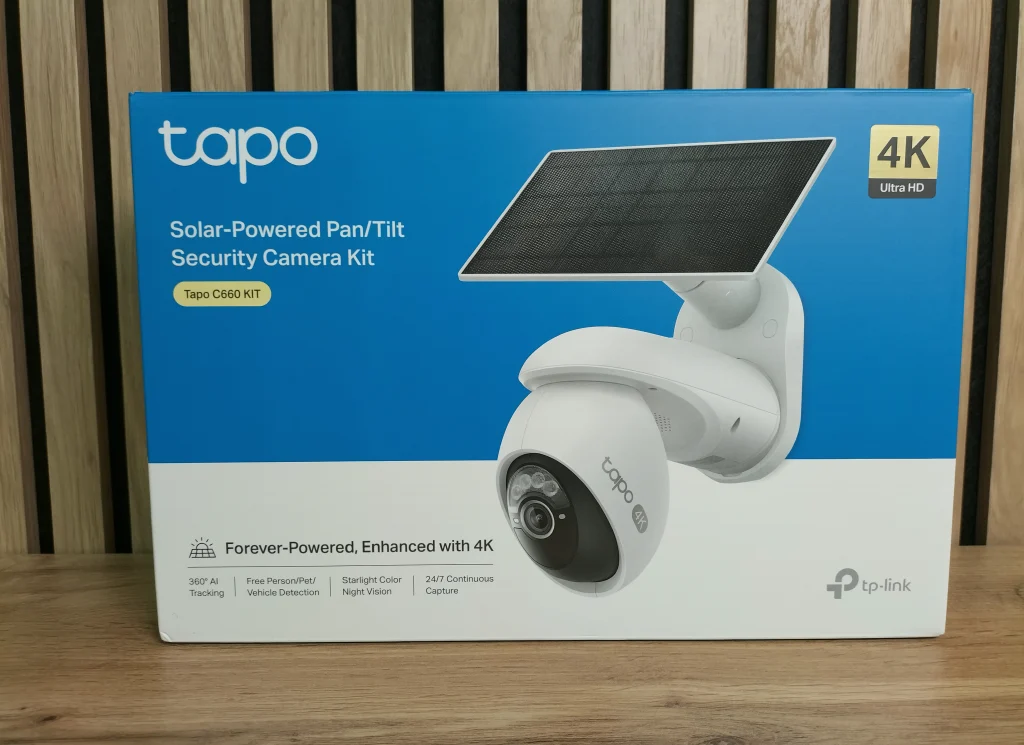
The Tapo C660 KIT is a battery-powered, solar-assisted outdoor Wi-Fi security camera kit designed for places where running power cables is impractical. It pairs a 4K rotating camera with a solar panel, adds AI detection for people, animals, and vehicles, and supports local recording—while its “24/7” mode works differently than continuous 4K recording on wired systems.
Key takeaways
- The kit pairs a 4K (8MP) camera with a 10,000 mAh battery and the included solar panel (Tapo A201, up to 2.5 W).
- Outdoor coverage is powered by dual-band Wi‑Fi (2.4 GHz + 5 GHz), and the camera rotates for 360° horizontal monitoring.
- It offers AI detection for people, animals, and vehicles without requiring an additional subscription for that feature.
- Local storage supports microSD cards up to 512 GB; the cloud option is via Tapo Care.
- The advertised “24/7” capture is not true continuous video; it takes interval snapshots until an event is detected, then switches to video recording.
What’s in the box and the full spec set
Beyond the camera and the solar panel, the package includes mounting hardware for both components, a 4-meter extension cable, a USB cable, screws, anchors, a cable tie, and installation templates and documentation. microSD cards and a 5V power adapter are not included.
Key specifications include:
- Video resolution: 4K (3840 × 2160), 8 MP
- Sensor: 1/2.7-inch Progressive Scan CMOS “Starlight”
- Lens: 4 mm, f/1.6
- Field of view: 105° diagonal (88° horizontal, 45° vertical)
- Frame rate: 15 or 20 FPS
- Digital zoom: 18×
- Night vision: 850 nm infrared up to 12 m, plus color “Starlight” mode
- Illumination: two built-in spotlights
- Pan/tilt: 360° pan range; up to 98° tilt
- AI detection: motion, people, animals, and vehicles
- Connectivity: dual-band Wi‑Fi (2.4 GHz and 5 GHz)
- Power: 10,000 mAh battery
- Solar panel: Tapo A201, up to 2.5 W
- Local recording: microSD up to 512 GB
- Cloud recording: Tapo Care
- Audio: built-in microphone and speaker
- Additional features: light-and-sound alarm, patrol mode, activity zones
- Weather resistance: IP65
- Operating temperature: -20°C to 45°C; charging temperature: 0°C to 45°C
- Camera size: 185 × 147 × 75 mm
- Integrations: Amazon Alexa and Google Assistant
Mounting and solar power reality check
The C660 KIT is larger than a typical fixed outdoor camera because it includes a rotating mechanism and the large battery pack. The housing is white plastic, while the lens, spotlights, and sensors sit behind a black front panel; the lighter finish may show dirt over time.
Installation options include wall or ceiling mounting. The USB-C port and the microSD slot are located on the rear of the camera behind protective rubber covers. Both the camera and the solar panel use an IP65-rated design.
The solar panel can be mounted directly above the camera or separately. The separate setup is usually preferable because the 4-meter cable lets you place the panel where it will receive more sunlight, while positioning the camera under an overhang or in the best viewing spot.
The manufacturer states that 45 minutes of direct sunlight per day is enough for typical operation. That estimate is tied to controlled conditions; real-world usage can increase power draw—especially with frequent alarms, heavy object tracking, 4K preview, and “24/7” activity. In colder climates, solar charging is the limiting factor: the camera can operate down to -20°C, but the battery charging function is only available from 0°C upward.
Setup and ongoing control are handled in the Tapo app. Dual-band Wi‑Fi is a key part of the design: 5 GHz is intended to provide higher bandwidth for 4K viewing, while 2.4 GHz is generally better for outdoor range.
4K image, night performance, and AI tracking
4K is positioned as the main advantage over common 1080p/2K models. Higher detail can help when you need to identify faces, read vehicle markings, or inspect events deeper in the frame.
The practical limits of the camera’s 18× zoom should be kept in mind: it is digital zoom, so image sharpness drops as you magnify. The camera is also capped at 15 or 20 FPS, which affects how smooth motion looks compared with wired 4K cameras that record at 25 or 30 FPS.
At night, the camera can use infrared (850 nm) up to 12 meters or switch to a color “Starlight” mode. A bright f/1.6 lens, a sensitive sensor, and two spotlights are intended to preserve color visibility in low light. Infrared is described as the more discreet option, while the spotlights can capture more detail and potentially deter people approaching the camera.
The rotating head supports full 360° horizontal coverage and about 90° in the vertical direction. Users can manually steer the camera, save preset positions, and run patrols between saved points. When the camera detects people, animals, or vehicles, it can automatically rotate and follow the moving subject.
AI detection for people, animals, and vehicles is available without an added subscription. Users can create activity zones and choose which event types trigger notifications. Two-way communication and a configurable light-and-sound alarm round out the feature set.
Recording options and what “24/7” actually means
The Tapo app provides live view, camera rotation, two-way talk, night mode control, detection configuration, and playback through a timeline. It also includes features like smart zoom tied to the tracked object, saved observation points, and filtering recordings by event type.
For local storage, the camera records to microSD cards up to 512 GB. The manufacturer estimates that the largest supported card can hold up to 379 hours of 4K footage. This approach avoids a recurring subscription for the most important functions. Cloud recording is available through Tapo Care, which includes features such as event history and thumbnail-style notifications. Compatibility is also noted with the Tapo H500 hub.
The biggest clarification is the “24/7 Capture” behavior. It is not continuous 4K video recording throughout the day. Instead, when no activity is detected, the camera records interval still images (producing a time-lapse-like sequence when viewed). Once it detects an event, it switches to normal video recording.
This design saves energy and storage compared to full continuous recording, but it may not capture the entire motion sequence leading up to detection in smooth form. “24/7 Capture” requires local recording (microSD) or a compatible hub, and it is not supported through the Tapo Care cloud service. Shorter intervals improve continuity, but they increase battery drain significantly.
Bottom line: strong kit value, with one key marketing caveat
The Tapo C660 KIT is positioned as a self-contained outdoor solution for monitoring areas like gardens, driveways, or entry points where installing power cables is difficult. The combination of 4K video, a 10,000 mAh battery, and the included solar panel provides more placement freedom than typical wired network cameras.
It stands out for AI detection without extra subscription requirements, local recording support, and features that matter in practice: rotating coverage, two-way audio, dual-band Wi‑Fi, and night imaging options. The “24/7” feature, however, is not equivalent to true continuous 4K recording; it uses interval snapshots until an event is detected, then records video.
Pricing is cited at roughly 640–650 in local currency. While that’s not inexpensive, the kit includes the camera, the solar panel, and the battery-based power system—along with functionality that, for many competitors, often pushes buyers toward paid subscriptions.