Grand Theft Auto V Uses Trevor Philips to Fix Open-World Storytelling Tension
Trevor Philips has long been one of the most polarizing characters in Grand Theft Auto V—and the reason isn’t just his brutality. Rockstar’s design uses him to resolve a long-standing problem with open-world storytelling: what the game asks players to do doesn’t always match what the narrative claims the protagonist feels. In Trevor, the studio turns that tension into a feature, pairing chaotic player freedom with a character built to rationalize, reject, and sometimes even critique the violent world around him.
Why GTA IV’s Niko Bellic didn’t fully match the player’s actions
Back in 2008, Grand Theft Auto IV struggled with an internal contradiction between its cutscenes and its sandbox. Niko Bellic could appear haunted by his past as a soldier and express remorse in cinematic moments. Meanwhile, the player could switch back to Liberty City’s open world and crush pedestrians between missions. This mismatch—often discussed as “ludonarrative dissonance”—was already something designer Clint Hocking had theorized as far back as 2007.
Rockstar’s own Dan Houser later described Niko as “too gentle” for the kind of unrestricted agency the open world offers, setting up the challenge the studio needed to solve for its next main entry.
Rockstar’s solution in GTA V: split the psyche, then let Trevor embody the player
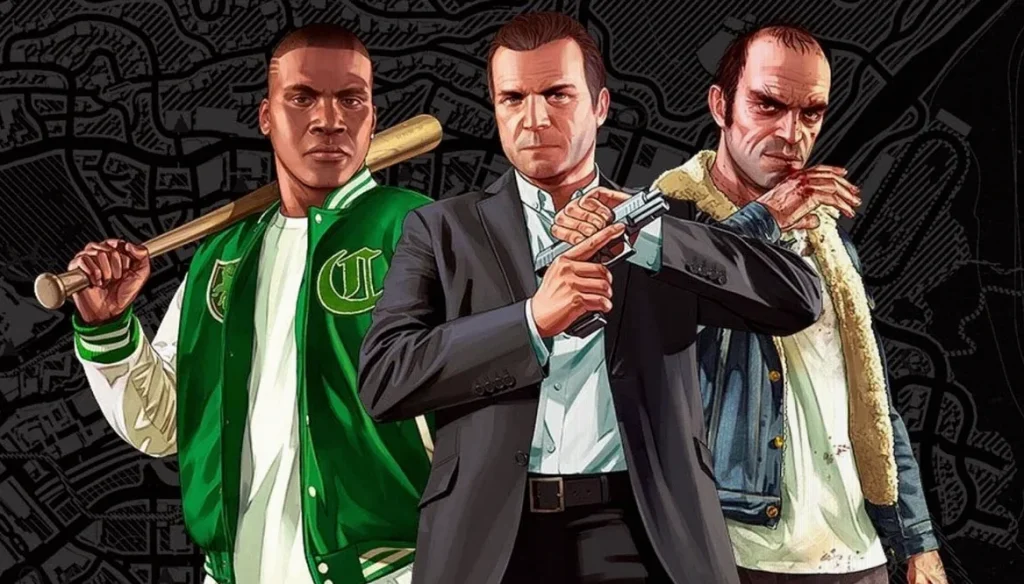
For Grand Theft Auto V, Rockstar restructured the character premise rather than trying to smooth over the contradiction. The story divides key aspects of personality into three figures: Michael represents a hypocritical “ego,” Franklin stands in for a more reasonable “superego,” and Trevor becomes the “id.” The result is that Trevor doesn’t just tolerate violence—his psychology is designed to legitimize the impulses players can act out on the controller.
-
Rockstar moves away from a single protagonist whose emotions must stay consistent across cutscenes and gameplay.
-
It assigns contrasting psychological roles to different characters—then builds Trevor specifically around the chaotic, impulsive side of player behavior.
-
With Trevor as the “id,” the game’s destructive actions (like explosive escalation and sudden flips in behavior) align with the character’s worldview, reducing the “player vs. narrative” conflict.
-
The character’s lack of guilt—combined with his willingness to cause mayhem—creates what is framed as an ideal ludonarrative harmony.
The approach is presented as a deliberate attempt to stop the game from asking players to ignore what they’re doing. Instead, Trevor becomes the embodiment of the player “off the leash,” giving chaotic actions a narrative rationale that stays consistent.
Trevor’s moral code: chaos with loyalty, and an anti-discrimination edge
Rockstar’s method also responds to repeated moral panic from critics in the media and politics. Rather than “toning down” the message, the studio builds an extreme character and forces the audience to inhabit him. Trevor can look like an irredeemable psychopath, but the writing presents him as having a more complex human side beneath the brutality.
His loyalty to people close to him is described as absolute. He’s also portrayed as having no patience for discrimination, including direct physical confrontation with racist groups associated with the “Minute Men.” He’s further characterized as protecting vulnerable people, with his affection for Patricia Madrazo cited as an example of the sincerity behind his violence.
The character’s complexity is tied to trauma: a background involving childhood abuse and the fallout of being abandoned. Even so, the writing doesn’t use that history as an excuse for his monstrous actions—Trevor remains someone players are meant to hate, while still being able to recognize the sharper logic and moral boundaries that surface through his worst moments.
A defining shock moment: Trevor’s GTA V entrance and what it signaled
Trevor’s arrival in GTA V is remembered as a blunt narrative jolt. The game begins by having him violently kill Johnny Klebitz, a hero from the GTA IV expansion. The move was seen by many as gratuitous provocation—yet the character’s construction is framed here as one of modern gaming’s more intelligent narrative designs.
In other words, Rockstar isn’t just introducing a villain; it’s establishing a protagonist whose unpredictability is the point, and whose existence recontextualizes the franchise’s chaos on both a gameplay and storytelling level.
Making the player complicit: “By the Book” and the political subtext
One mission is highlighted as a clear demonstration of this design philosophy: “By the Book.” In that sequence, the player directly carries out physical torture on an innocent on behalf of the FIB. The writing emphasizes how Rockstar uses direct, hands-on analog input to break emotional distance—turning the player into an active participant in the horror rather than a detached observer.
Then, immediately afterward, the irony flips. Trevor spares the victim and brings him to the airport. During the drive, Trevor delivers a sharp critique of torture, describing it as a tool for asserting state power rather than anything morally justified.
The takeaway presented is that Trevor functions as a mouthpiece for political critique aimed at American institutions in the post-9/11 era. The character isn’t framed as mere permission for sandbox mayhem; instead, his contradictions make his rare moments of clarity hit harder, because they arrive from someone who otherwise embodies the player’s darker impulses.
Steven Ogg’s performance: capturing the range between menace and dark humor
Trevor’s impact is also credited to Steven Ogg’s performance. The role was recorded using full motion capture, with Ogg bringing a “nervous” approach and a wild expressiveness to the 3D model.
What pushed the performance into a distinct register, according to the account here, was Ogg drawing from Tom Hardy’s portrayal of Bronson (2008). That influence is described as helping him constantly shift between terrifying mania and black comedy—an ability that makes Trevor’s extremity feel controlled rather than one-note.
The result is a character performance that earned major recognition, including a BAFTA nomination and global visibility tied to Ogg’s work. Even with an ambivalent relationship to the role later, his portrayal is credited with cementing Trevor as a standout figure in the video game medium—transforming one of the franchise’s most abject personas into a high point of game design.