Kioxia CM10 Server SSDs Hit 28GB/s with PCIe 6.0 and BiCS10 NAND
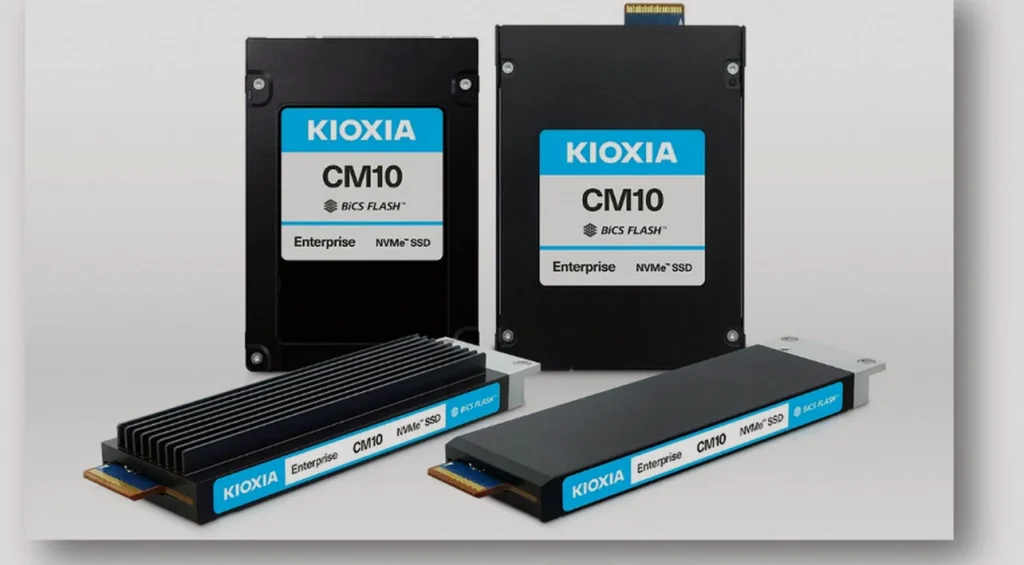
Kioxia has unveiled its new CM10 line of server SSDs, bringing two notable upgrades to enterprise storage: PCIe 6.0 support (with peak sequential throughput claimed to top 28 GB/s) and a first use of its next-gen BiCS10 3D NAND. The company is positioning CM10 for data-center and AI workloads such as inference and context caching, with compatibility aimed at modern NVMe server platforms.
Release timing and availability
Kioxia is showing the CM10 series via samples for now. The company indicates that these are pre-production units, and that full series production is expected to take additional time. More details are expected to be shared during the Future of Memory and Storage (FMS) event.
| Platform / form factor | Status | Date / window |
|---|---|---|
| CM10 PCIe 6.0 server SSDs (E3.S, E1.S, 2.5-inch) | Samples shown; mass production not confirmed | Now (event preview); series production later |
| Additional CM10 details | Planned presentation | Future of Memory and Storage (FMS) |
CM10 specs: PCIe 6.0 performance claims and capacities
The company does not provide a full datasheet, so the performance numbers are presented as high-level claims rather than complete specifications. Kioxia says CM10 improves on the CM9 generation with:
- Up to 92% faster sequential read
- Up to 85% higher random read performance
Using the CM9 reference points cited by Kioxia’s presentation, the implied targets are approximately 14.8 GB/s sequential read rising to about 28.4 GB/s, and random read performance increasing from roughly 3.4 million IOPS to up to 6.29 million IOPS. Kioxia did not list any write performance figures in the announcement.
CM10 will be offered in multiple form factors: E3.S, E1.S, and 2.5-inch. Capacities range from 1.60 TB to 61.44 TB depending on the format. For cooling, Kioxia supports “Direct-Cold-Plate Liquid Cooling” for the E3.S and E1.S designs (noting that all listed form factors also support traditional air cooling).
Enterprise endurance / workload positioning
Kioxia says the CM10 line is built for demanding enterprise and AI workloads, specifically calling out AI inference and context caching. It also references NVIDIA’s CMX architecture, which extends beyond GPU memory to tie in fast flash storage.
Endurance options mentioned include:
- Read-intensive configuration: 1 DWPD
- Mixed-use configuration: 3 DWPD
BiCS10 NAND debut: 332 layers and interface improvements
CM10 is the first Kioxia server SSD series to use the company’s BiCS10 3D NAND generation (partnered with Western Digital’s SanDisk branding in Kioxia’s production framing). Kioxia previously announced that BiCS10 sampling had begun at the start of the month.
The BiCS10 used here is specified as BiCS10 TLC with 332 cell layers. Kioxia claims this delivers the highest areal density so far at roughly 29 Gbit/mm². Compared with BiCS8, the interface is said to be accelerated by 33%, up to as much as 4,800 MT/s, along with improved energy efficiency.
Standards, cooling, and security features
Kioxia lists CM10 compliance and feature support aimed at current data-center NVMe deployments, including:
- PCIe 6.0 compliance, NVMe 2.1, and OCP Datacenter NVMe SSD Specification 2.72
- Support for NVMe Flexible Data Placement (FDP)
- Form factor support across E3.S, E1.S, and 2.5-inch
- Liquid cooling option via Direct-Cold-Plate for E3.S and E1.S (air cooling supported across all listed formats)
- Security options including SIE, SED, and SED FIPS 140-3 (planned)
- Post-quantum cryptography guidance via CNSA 2.0 recommendations
- SPDM 1.4 attestation support
What’s known—and what’s still missing for buyers
For players and hardware enthusiasts following server storage, CM10 is an early signal that PCIe 6.0 SSDs are moving from niche deployments toward broader platform readiness, especially as new CPU server platforms roll out. However, buyers looking for detailed planning inputs will need to wait: the announcement does not include a full datasheet, and write performance figures are not provided.
With the CM10 line currently described as samples, series availability remains the biggest unknown, even as Kioxia signals more information will arrive during FMS. The next step for anyone evaluating these drives will be to confirm production timelines, final performance/latency characteristics (including writes), and validated platform support once PCIe 6.0 systems become more widely available.