Tales of Eternia Remastered Details New QoL, Controls, and Original Mode Options
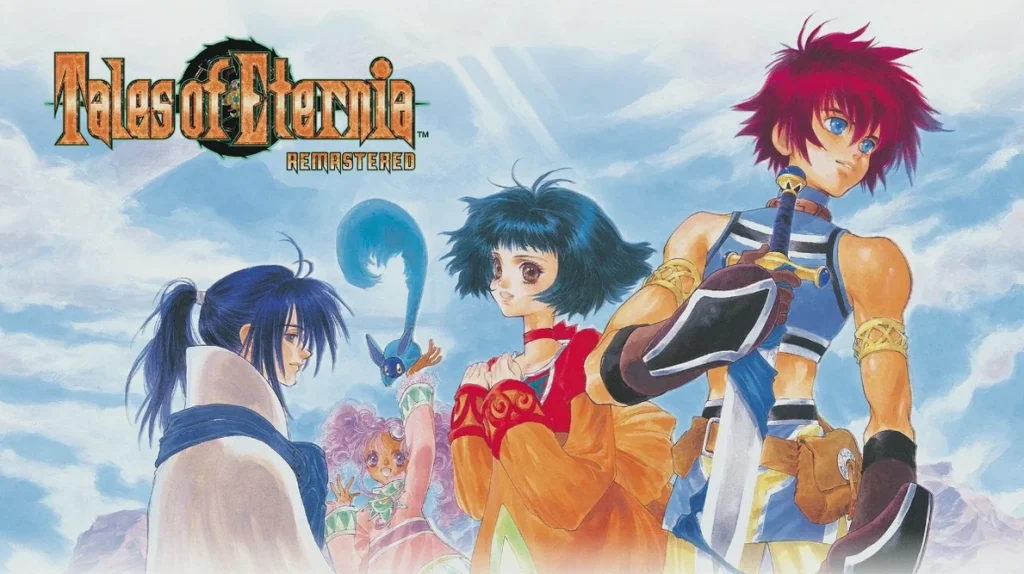
Bandai Namco has detailed a wide-ranging set of upgrades planned for Tales of Eternia Remastered, including quality-of-life improvements for exploration and combat, new accessibility-style controls, and multiple options that let players switch back to the game’s original presentation. The publisher says the remaster will launch with updated graphics and revised audio, while also including toggles to swap to the original visuals and sound effects.
What’s changing in Tales of Eternia Remastered
Among the announced changes, the game will add a yellow “!” destination marker in the main scenario, with the distance to the destination shown alongside the icon. Players will be able to turn these destination icons on or off through Menu > Custom > “Destination Icon,” with the note that some path gimmicks may not display icons.
Bandai Namco is also adding clearer guidance for optional objectives and progression moments. A “★” icon will mark locations of valuable items such as encyclopedias and maps, again accompanied by distance information, and controlled by the same Destination Icon toggle. Timed acquisition events will receive an hourglass icon, while learning new skills and techniques will be marked with a blue “!” icon—both with distance shown and both toggleable via Menu > Custom > “Destination Icon.”
For pacing and retries, the remaster will include a “Boost Function” intended to smooth progression. It can be enabled or disabled at any time from Menu > Custom > “Boost Function,” except for a few items. If players lose a regular battle and receive a game over screen, the game will allow a “Battle Retry” option from the game over menu.
To reduce downtime, the update list includes skip controls for events, skits, and movies. Players can skip by long-pressing the relevant button, while a separate pause function is planned for event skit movies. When paused, a skip guide will appear, letting players skip directly.
Saving and recovery are also being reworked. The game will autosave at specific points, including after moving to a new map and after an event ends, with auto-save data located at the top of the load screen. A “quick recovery” feature will let players heal all party members’ HP and status ailments at once, with the healing method and percentage selected via a menu prompt.
Movement and combat speed are getting multiple layers of control. While navigating fields, players will be able to move quickly by holding the corresponding button during movement. There will also be a way to set the default movement style to either walking or fast movement from Menu > Custom > “Movement.” In addition, when using the “AUTO” combat mode, pressing a button will switch combat into high-speed mode, and pressing again returns combat to normal speed.
Presentation options appear throughout the settings list. Under Menu > Custom, a “Graphics Mode” option will allow switching between “Remastered” and “Original,” while the interface remains the same in either mode. A separate “SE Mode” option will let players switch sound effects between “Remastered” and “Original.”
Bandai Namco is also adding more controls for audio content and playback. A “Sound Player” option will be available in Menu > Custom, enabling playback of BGM and SE. For later playthroughs (starting with a cleared save), additional options are expected to appear for “Battle Voice,” “Scenario Voice,” and “Movie Select,” allowing players to play voice and movie content. The publisher also notes that the original version’s “Sound Test” feature in the sound volume control will not be included in the remastered edition.
Skits and replayability are being expanded as well. A “Skit Player” option and skit titles will be added to Menu > Custom. During the first playthrough, players can replay most previously viewed skits, with a few exceptions. From the second playthrough onward—starting with a cleared save file—Bandai Namco says all skits will become playable.
To streamline story delivery, there will be an “Automatic Message Sending” toggle for event and skit messages. The update list also includes subtitles for skit movies, and subtitles appearing during some mini-games. Subtitles will also be added to post-battle results screens, covering victory voice and Mystic Arte lines, with an on/off toggle via Menu > Custom > “Battle Subtitles.”
Further system changes include letting players return to the title screen from the menu via Menu > System (“Return to Title”), and adding a menu “Load” option to jump directly to the loading screen.
Players will also be able to customize controls. Key bindings for battles and for field/town/dungeon navigation can be changed through Menu > Custom > Button Settings. A “Voice Language” option under Menu > Custom will allow switching between Japanese and English voice prompts. For overall audio tuning, Menu > Custom > Sound Volume will include a “Master Volume” slider controlling background music, sound effects, and voiceovers, along with sample playback buttons for both “SE Volume” and “Voice Volume.”
Brightness adjustment is also planned via Menu > Custom > Brightness Adjustment, and the game will provide additional guidance tips as players progress. Some tips may be found in Menu > Custom > Help, alongside explanations of in-game functions and terminology.
On the gameplay design side, dungeon gimmicks and mini-games that originally relied on color identification will be subtly redesigned so players can identify them using elements other than color. The “Tales” quiz sub-event in the academic town of Mintz will also be updated with completely new questions.
Bandai Namco is changing availability and structure for certain content across playthroughs. “Nereid’s Labyrinth,” previously accessible only in later playthroughs after clearing save data, will instead be unlocked on the first playthrough when players reach the interior of “Balir Castle.”
Combat difficulty selection will also differ from the original. The “Mania” combat level, which was previously unlocked only after the second playthrough, can be selected from the start of the first playthrough in the remaster, with changing controlled through Menu > Custom > “Combat Level.” A newly added “Unknown” combat level will become selectable from the start of the second playthrough onward. A “Battle BGM Settings” option will let players use selected songs for battle background music during random encounter battles, but only for players who purchased the Deluxe Edition or Deluxe Upgrade Pack.
When new techniques and skills are learned, they will be highlighted in green text. Button guides will be added across multiple screens, and in fields, towns, and dungeons a guide will appear if no action is taken for a set period of time.
Carry-over and content availability changes
From the second playthrough onward, cleared save data will trigger a data transfer settings screen. Players can choose which elements to transfer by turning items on or off, with the exception that titles will not be transferred. The transfer list includes Character Information, learned techniques and skills, items in possession, lens availability, cooking recipes, command, and both the Collector’s Encyclopedia and Monster Encyclopedia.
Not every legacy feature is returning. Bandai Namco says the original character name change function will not be implemented in the remastered version. The publisher also mentions adjustments to some expressions, effects, and design elements, plus updates to UI elements and the addition of new UI components. Typos and omissions from the original text will be corrected.
Tales of Eternia Remastered releases for Nintendo Switch 2 and Switch on October 16, 2026.