
Honor Robot Phone Launches With 4DoF Robotic Camera Arm and AI Tracking
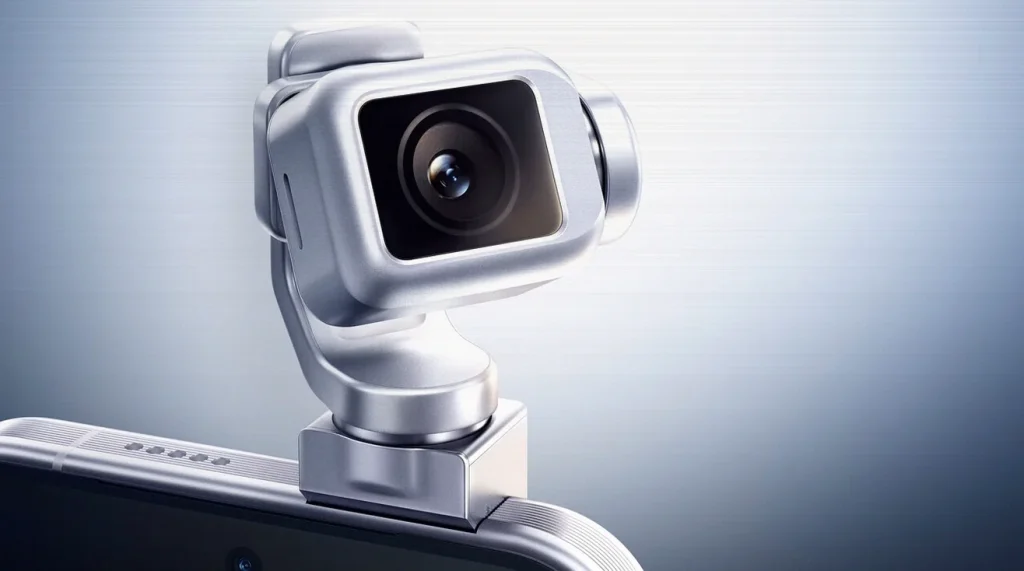
Honor has unveiled its “Robot Phone,” a camera-focused smartphone that physically moves its camera module using a robotic arm. The company’s goal is to take stabilization beyond gimbals alone: a 4DoF mechanism can pan, tilt, rotate and perform flips, while AI aims the lens at subjects in real time—at a launch price that places the device firmly in the premium tier.
Release timing and availability
Honor is launching the Robot Phone first in China. Pre-orders and sales begin “tomorrow” after the announcement, with pricing set at the equivalent of about €1,300 for the 12GB/512GB version. A higher-capacity 1TB model is offered at the equivalent of about €1,660.
| Platform | Status | Date / window |
|---|---|---|
| China | Available for purchase | “Tomorrow” after announcement |
Honor has already shown the concept multiple times at its own events and trade shows, including a larger appearance at MWC, where the Magic V6 was also introduced. The company has not announced a wider international rollout in the information provided.
Robot arm + 4DoF gimbal: stabilization with real perspective movement
Instead of keeping the camera module fixed inside the chassis, Honor designed a motorized mechanism that can move the module itself. The system uses a compact 4DoF gimbal approach: a three-axis mechanical gimbal for stabilization plus an additional freedom degree for broader camera motion.
Honor describes the four motion axes as Pan, Tilt, Roll, and Flip. That means the device can compensate for more than just shake—moving the camera’s perspective is part of the design.
Honor claims the gimbal architecture includes “more than 100 precision components” and is produced through 60 manufacturing steps, with over 100 patents feeding into the development. The company also states the gimbal dimensions have been reduced by 65% compared with external gimbal designs, while reporting 200% higher stability in its own internal comparison testing (not directly comparable to other gimbal measurements).
Motors and performance claims
- A titanium gimbal motor, weighing 2.6 grams, is included.
- In “Robot Mode,” Honor says it can reach up to 360 degrees per second.
- A separate “Super Steel Flip Motor” is described with a torque density of 120 Nm/L, designed to enable fast camera-module movements despite a smaller build size.
AI-controlled motion modes for vlogging and calls
Honor says the Robot Phone uses its mechanical movement alongside AI to track and adjust for subjects in real time. Unlike digital tracking that only shifts a crop inside the image, Honor’s approach physically moves the optical axis.
The phone includes functions such as “AI SpinShot,” which can execute controlled rotations of 90 or 180 degrees to create transitions that would otherwise require digital post-processing or an external gimbal. It also lists motion modes including Tilt Lock, First Person View (FPV), and FPV Vertical, aimed at keeping the camera aligned with a subject while the user moves.
Honor positions these features for use cases like vlogging, livestreaming, and video calls—where the person in front of the phone can move while the camera module adjusts its perspective on its own.
Triple-camera array: two 200MP sensors plus an ultra-wide
For image capture, Honor equips the Robot Phone with three high-resolution sensors:
- Main camera: 200MP sensor (1/1.28-inch) with an f/1.6 lens. The module connects to the gimbal and is stabilized both mechanically and via optical image stabilization.
- Telephoto: 200MP periscope camera with a 1/1.4-inch sensor, offering 2.7x optical zoom versus the main camera, plus optical stabilization.
- Ultra-wide: 50MP sensor with a 122-degree field of view.
ARRI partnership brings “cinema” image pipeline features
A major differentiator is a cooperation with German film equipment maker ARRI. Honor says the partnership goes beyond a simple look preset, integrating elements of ARRI’s “Image Science” and parts of professional production workflow processing into the Robot Phone’s imaging pipeline.
For the main camera, Honor supports an ARRI Cinema Mode that records 10-bit video with LogC3, alongside ARRI Wide Gamut 3 and ARRI Looks. Honor’s stated aim is greater flexibility during later color correction.
Honor also details LogC3: rather than mapping sensor brightness directly to display-friendly tone curves, the profile redistributes brightness information to retain more usable detail in both bright and dark areas. The result is described as looking flatter and less contrasty on-screen initially, but with more headroom for post production.
Honor claims a dynamic range of up to 14 stops, while emphasizing that such figures are theoretical or based on defined test conditions and should not be treated as directly equivalent to a 14-stop professional cinema camera.
On the processing side, Honor says noise reduction happens already in the RAW domain, followed by additional processing in 14-bit and 4:4:4 before outputting 10-bit LogC3 and 4:2:2. Honor also says ARRI Looks can be previewed during capture, and the resulting footage can be used in editing and grading tools such as DaVinci Resolve.
Performance and charging: Snapdragon 8 Elite Gen 5 plus 7,060 mAh
Honor powers the Robot Phone with the Snapdragon 8 Elite Gen 5 chipset. For long recording sessions and sustained AI processing, the company says it includes a dedicated cooling system designed for the heat and load generated during continuous recording with active AI object recognition.
Power comes from a 7,060 mAh battery made with a silicon-carbon design. Honor supports 120W wired charging and 50W wireless charging via “SuperCharge.”
Display: 6.31-inch LTPO OLED with very high peak brightness
The front display is a 6.31-inch LTPO OLED panel with an adaptive refresh rate that can vary from 1Hz to 120Hz. Honor lists a maximum peak brightness of 6,800 cd/m².
To reduce visible flicker at lower brightness levels, Honor uses PWM dimming at 4,320 Hz. The display protection is provided by Honor’s “NanoCrystal Shield,” rather than naming third-party glass like Gorilla Glass.
What’s still unclear for players and buyers: Honor has announced China as the initial market, but the provided details do not confirm pricing and launch timing for other regions. It also does not specify exact availability of the AI tracking behaviors across languages, app integrations, or whether the camera-module movement will be available in all capture modes or only specific shooting scenarios.