Sound Blaster Audigy FX Pro Review: PCIe Audio Upgrade for Cleaner 7.1 Sound
Sound Blaster Audigy FX Pro is a new internal PCIe sound card aimed at fixing a very common PC problem: when your build is optimized for GPU, storage, or RAM, the audio stack can end up as a weak link. With a quoted up-to-120 dB signal-to-noise ratio, 7.1 analog output over 3.5 mm mini-jacks, and a software suite built for quick tuning, it targets players who want a cleaner analog signal and better control without buying an external DAC.
What the Audigy FX Pro actually brings to a gaming PC
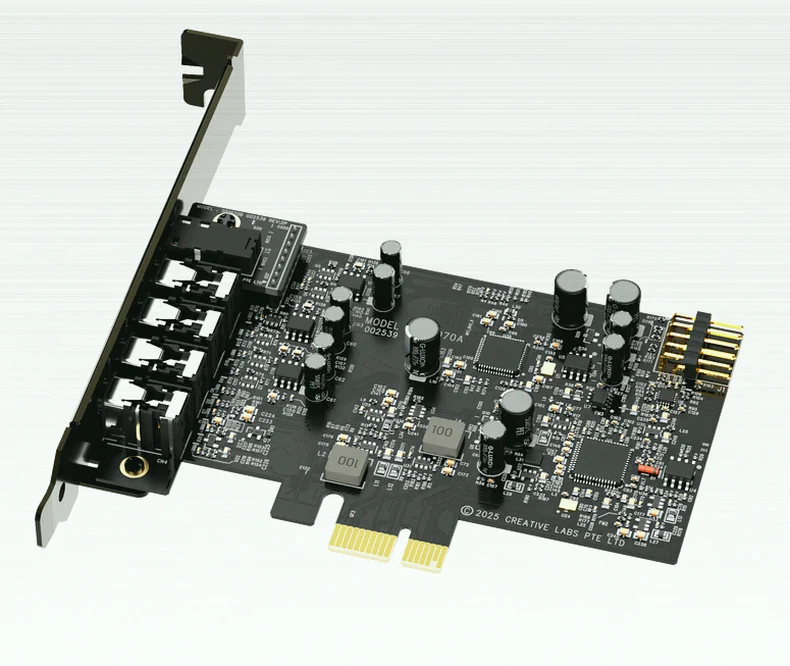
The Audigy FX Pro is designed as a PCIe x1 card, positioned as an upgrade path when onboard audio feels noisy, unstable, or simply not detailed enough—especially on prebuilt systems. Its core pitch is “cleaner analog output,” and the measurable specs are part of that story: it’s rated for a signal-to-noise ratio up to 120 dB, with a reported verification at 118 dB, alongside very low distortion (THD+N listed at 0.003%).
In practical listening, the change is described as noticeable quickly on analog outputs: less background noise and improved clarity for both spoken dialogue and in-game ambience. The point isn’t that it turns a PC into a studio rig, but that it can produce a more readable sound when the rest of the system isn’t doing audio well.
Analog multichannel first: 7.1 via mini-jacks and a more PC-friendly setup
Unlike many external solutions that start from “digital in, headphones out,” this card leans into PC-style connectivity. It supports PCM playback up to 32-bit/384 kHz and recording up to 32-bit/192 kHz, giving headroom for different sources. For outputs, it highlights multiple 3.5 mm jacks to enable 7.1 analog through a compatible speaker kit.
There’s also a digital output option: SPDIF using a mini-TOSLINK / combo setup. For headphones, the card includes amplifier-related specifications intended to help you match the load—support for headphones rated from 32 to 300 ohms, with an output impedance of 4.7 ohms.
- Cleaner analog output is the main upgrade point, particularly when onboard audio struggles.
- 7.1 analog is routed through multiple 3.5 mm mini-jacks for a compatible PC speaker setup.
- SPDIF is present, but it’s framed as more suitable for simpler digital stereo use.
- Headphone compatibility is supported for 32–300 ohm loads, with 4.7 ohms output impedance.
Creative Nexus: the tuning layer that changes how games sound
The most “daily driver” value comes from the software. Creative Nexus provides a 10-band equalizer, profile handling, and a set of effects grouped under the Acoustic Engine concept. The feature list includes surround virtualization, Crystalizer, bass adjustments, volume management, and dialogue emphasis.
The practical advantage is that you can start from a cleaner baseline and then shape the presentation for a specific use: gaming, films, or a more neutral preference. The suite also includes modes aimed at gameplay cues, including a Scout Mode intended to bring out certain in-game sonic indicators.
However, the review framing emphasizes that the best results come from adjusting—especially if you want a competitive-friendly signature. Some game-oriented modes can shift the sound character enough that music may feel less natural, which is presented as a trade-off rather than a flaw.
Where it may not fit: SPDIF limits, reliance on onboard starting point, and USB DAC convenience
The Audigy FX Pro’s value depends heavily on what you’re upgrading from. If your motherboard audio is already strong and quiet, the difference may be real but not essential. The card is positioned as a targeted upgrade for prebuilt PCs where audio is often the last-budget component, or for systems where onboard output gets noisy or struggles with a demanding headphone.
It also isn’t a universal “replace everything” solution. A key concern is how SPDIF behaves for modern home theater expectations: while it can be useful for clean digital stereo links, the lack of Dolby Digital and DTS support limits its usefulness for multichannel home cinema setups relying on an all-optical chain.
Finally, there’s an ergonomic argument against internal PCIe cards for some users. If you frequently swap headphones or want “DAC on the desk” convenience, an external USB DAC/amplifier can be more practical. The review notes that while internal installation avoids extra boxes and power, it can be less comfortable when you constantly connect and disconnect different headsets.
Creative Nexus tuning also matters for expectations: buying a sound card purely to get “correct” sound immediately misses the product’s real value, which is shaping the output. In short, the Audigy FX Pro is best when you have a specific need (cleaner analog and multichannel) and you’re willing to spend a bit of time configuring it.
Pricing and positioning
The recommended retail price is listed at 69.99 EUR. That places it in an accessible segment, and the overall assessment is consistent with that role: it’s not positioned as a replacement for premium external audio chains, and it doesn’t aim to cover every possible digital home-theater scenario. The strongest rationale is improving analog cleanliness and adding flexible PC-oriented multichannel output without requiring an external DAC.