Denshattack Hits Switch 2 on July 15, 2026 With Speed, Tricks, and Rebellion
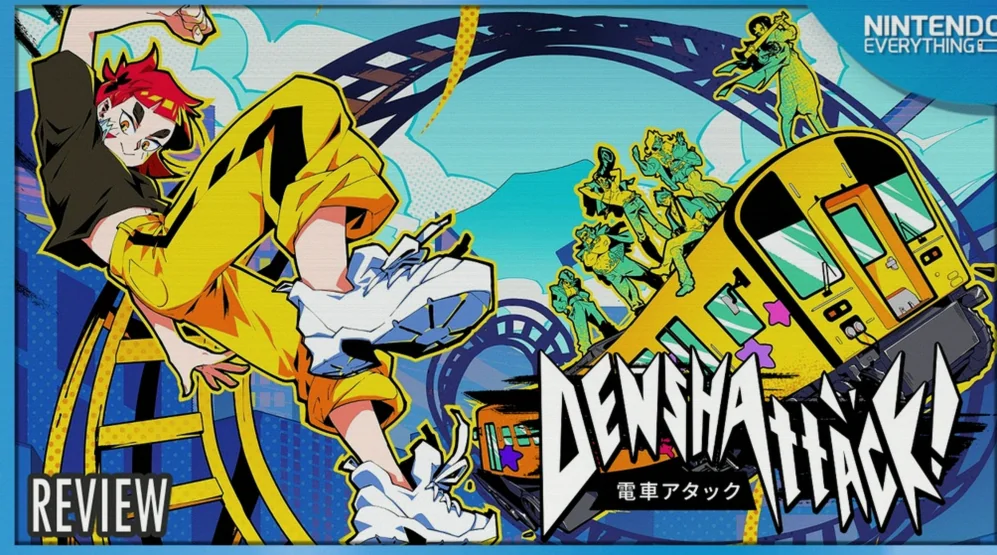
Switch 2 players who like high-speed, trick-heavy action now have a date to circle: Denshattack is set to arrive on July 15, 2026, published by Fireshine Games and developed by Undercoders. The game blends fast train traversal with stylish momentum tricks, and it leans hard into a dystopian rebellion story—one that feels as energetic as the gameplay itself.
Release timing and availability
System: Switch 2
Release date: July 15, 2026
Developer: Undercoders
Publisher: Fireshine Games
| Platform | Status | Date / Window |
|---|---|---|
| Switch 2 | Announced | July 15, 2026 |
While the premise might sound like a riff on familiar extreme sports momentum—tricks, speed, and flair—this train-focused racer-adventure is designed to be much more than a quick comparison. If you’re looking for an arcade-style experience with a strong narrative backbone and frequent set-piece escalations, Denshattack is built to keep you moving, even if the learning curve asks for patience early on.
Story setup: domes, propaganda, and a rebellion on rails
Set in a dystopian future, the Japanese government partners with the Miraidō Corporation to cover major cities with massive domes, drawing inspiration from a famous animated feature. More than 70 percent of the population lives inside these structures, while the company’s mascot, Molty, appears on television to promote how wonderful life is within the spheres. Outside the domes, life is different—and one of the people living beyond them is the young noodle chef protagonist, Emi Araki.
During a delivery run, Emi crosses paths with a rising journalist named Fernando. He introduces her to Denshattack, where train drivers take to the tracks for high-speed, style-first performances—part creative outlet, part open defiance of Miraidō. Emi chooses to travel with Fernando to the next region, aiming her rebellion at the mega-corporation’s operations and working to end Miraidō’s control.
The campaign follows a shonen-style rhythm: Emi faces new opponents, adapts under pressure, and finds a new technique to overcome each challenge and grow stronger. The structure is meant to deliver that satisfying “I’m getting better” feeling in the middle of the action. Emi is also portrayed as a genuinely upbeat character, especially striking in a bleak world where domed life offers no sun or sky. Her optimism spreads through her core group as the plot moves forward, creating an endearing tone that helps the story land over a roughly 10–15 hour campaign.
Onsen side visits and extra character moments
Beyond the main run, the game includes Onsens you can visit. These breaks let characters relax in hot springs away from the action and chat casually—adding story details that don’t always appear in the central missions. Examples mentioned include how Emi acquired her train, as well as how Madoka and Yamagata know each other.
The game’s themes—how the future feels hollow and dominated by corporate control, and how creative expression suffers as a result—are presented clearly, and they’re positioned as a key emotional driver for the rebellion narrative.
How Denshattack plays: prefectures, stages, tricks, and medals
At its core, Denshattack tasks you with moving your train from point A to point B through courses laid out across the map. The world is divided into nine prefectures, and each one contains multiple stages plus a boss confrontation at the end against that area’s gang leader.
Progressing through a stage means chaining a variety of movement options. Players can flip between tracks, drift through corners, jump over obstacles, grind on rails, ride along walls, and more, with each stage encouraging different combinations. After completing a stage, your performance is evaluated with a medal-style ranking system: no rank, bronze, medal, and gold.
Your medal outcome is influenced by several factors, including the trick-based high score you earn, how well you complete the course’s “dare” sub-missions, and how quickly you finish the level. Extra points may also be awarded for clearing a stage without crashing. Each course also includes collectible items, which can be exchanged at the garage to buy new trains, customize the ones you own, and expand Fernando’s Fanzines—his journal-style writeups covering the region, its people, and various trivia.
Mission variety: score challenges, rival races, and objective stages
To keep things from feeling repetitive, Denshattack mixes in different mission types. Some stages play like skate-park challenges where the goal is to outperform a high-score target through skilled trick execution. Other segments are races against rival gangs, where the objective is to place in the top three. There are also missions built around specific objective checklists—often requiring environmental manipulation or collecting sets of items to unlock the next part of the campaign.
Boss fights stand out as well, with encounters that aim to outshine the one before. They’re described as a major highlight of the overall experience.
What stands out most: stages that keep escalating
The biggest takeaway from the gameplay experience is that the stages are consistently fun, from the opening prefecture to the final level. The game repeatedly tries to outdo itself with fresh set pieces, and the rush of stacking tricks together while reacting quickly—and swapping moves on the fly—creates a sense of adrenaline that’s hard to put down once you’re in rhythm.
Learning curve: fun at speed, tough at first
That said, the game’s biggest friction point is how steep it feels to master. Denshattack introduces many mechanics very early, and each new prefecture adds more tools to Emi’s movement kit. The experience is compared to learning a high-speed hoverboard-style game from childhood—similar in vibe and presentation, but also requiring time to truly click.
Early on, it can be discouraging to feel like inputs aren’t landing, reaction timing isn’t matching the demands of the tracks, and getting stuck on the same portion of a level can quickly turn frustrating.
Fortunately, the game is described as not overly punishing when you crash. Instead of a life system, crashes return you to a spot slightly behind where you went down. During the first hours, it was easy to miss drifting and jumping controls, and when fast input timing is needed to avoid dangerous obstacles, panic can lead to mistakes. The note here is that this may come down to personal comfort with this style of play, but the impression is that the move list may be slightly too dense for its own good—specifically suggesting that stages featuring a two-track sideways slide mechanic wouldn’t lose anything if the input were handled more directly, such as with a single trigger-style prompt.
Checkpoints, ranks, and how technical goals change the pressure
Even with the complicated move options, the spectacle remains intact, and the experience is softened by frequent checkpoints across each level. That means crashes and wrong moves don’t usually wipe out meaningful progress. The situation becomes more serious mainly when chasing gold medal rankings. In the described playthrough, the highest achieved rank was silver, and the expectation is that other players will find ways to optimize point returns through trick combo mastery.
Day-one patch promise: collision issues and rare glitches
The review also flags occasional collision-detection problems seen in a small number of stages. Undercoders has reportedly already acknowledged these issues and plans to address them via a day-one patch. The glitches were encountered only a handful of times during about 15 hours, described as roughly half a dozen occurrences, making them rare compared with an otherwise smooth physics feel.
There was also mention of frame drops and slowdown only once during a late-game boss fight. Aside from that, performance is characterized as steady, maintaining a high frame rate both in handheld and docked play.
Presentation: cel-shaded style, Japanese flourishes, and the late-90s/early-2000s vibe
Visually, Denshattack is praised for capturing a specific nostalgia window—late 1990s into early 2000s energy. Stage visuals use cel shading, and moves are accompanied by frequent flourishes of Japanese text. Voice lines also encourage you when you perform well. Sound design includes disc-scratching effects after successful trick chains or mission completions, reinforcing the rebellious theme.
The overall sentiment is tied to a feeling of rediscovering a lost slice of that era. The game’s creator inspiration and cultural references are described through comparisons to Jet Set Radio, watching Malcolm in the Middle during childhood, and hearing Bleach’s first opening “Asterisk” by Orange Range. The result is a constant grin-inducing tone throughout the run, even if it doesn’t translate into literal “spray paint the corpo building” behavior.
Audio options: dual-language casts and on-the-fly dub switching
Presentation extends into character art and voice work. The game includes two full voice casts—Japanese and English. A notable feature allows players to switch between the dubs during gameplay by changing the audio language in settings. The campaign and save file are not tied to a single language, enabling a single playthrough to experience both dubs.
In the described experience, the Japanese dub was ultimately preferred due to how naturally the performances land across the cast. The English dub’s main characters—Emi and Fernando—are also called out as strong performances, though some supporting character voices in English were found slightly distracting.
Soundtrack: Tee Lopes-led music with a wide roster of contributors
If there’s a single “must experience” reason beyond everything else, it’s the soundtrack. The lead composer is identified as Tee Lopes, known for Sonic Mania, and the quality is immediately noticeable after a few stages. The music is described as consistently skilled at producing ultra-catchy, memorable tracks.
Undercoders also reportedly assembled a larger lineup of high-energy artists for the score, including Richard Jacques (Sonic R), Takenobu Mitsuyoshi (Virtua Fighter / Daytona USA), Alice Parelta (Splatoon), and Shoji Meguro (Persona), among other credited contributors. The music spans multiple genres, including rock, hip-hop, and electronic styles.
One wish mentioned: a free-roam mode where players could travel through Japan at leisure while selecting different songs from the soundtrack.
Bottom line: arcade fun with a message, plus a few early hurdles
Denshattack is positioned as a nonstop thrill ride that keeps raising the stakes from one prefecture to the next. For players willing to invest time into the controls, it’s described as among the most enjoyable arcade-style games in decades, with the key caveat that the early learning curve can sideline some people.
The foundation is also framed as something that could support a larger franchise, thanks to a cast of characters players would like to see return. While there are a few small technical hiccups, those are expected to be corrected via updates. What should remain is a highly entertaining game with a clear message meant to leave an impact.
Finally, pricing is cited as a low $20 for the amount of content included, with the hope that players “hop on board this train” and attempt the impossible—fighting the power as the story and stage design demand.
Denshattack copy provided by the publisher for the purposes of this review.