
Gamer Uses Gallium Vial to Fix GPU Sag—Turns Into Corrosion Warning
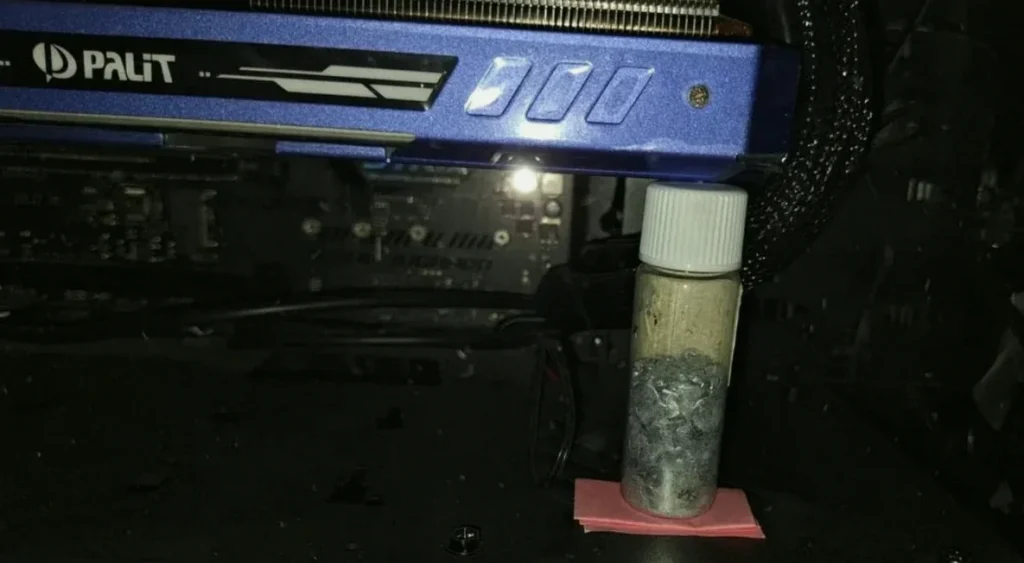
A PC gamer tried to stop his heavy graphics card from sagging by wedging a small plastic vial of gallium under it—an “ingenious” visual thermal idea that quickly turned into a warning story about temperature, corrosion, and why this kind of hardware improvisation is extremely risky.
Why GPU sag is getting worse
Over the last few years, graphics cards have grown heavier as cooler designs have become bulkier and multi-fan setups have become common. Some high-end models now tip the scales at around or above 2 kg.
When a card is mounted horizontally on the motherboard, that weight can eventually cause it to sag. More importantly than looks, the constant mechanical stress can damage the PCI Express connection over time, potentially harming the motherboard and even cracking the graphics card’s PCB.
To counter gravity, the community often relies on simple, inexpensive fixes—everything from improvised stands (like LEGO-style supports or other household items) to adjustable metal anti-sag brackets sold by hardware makers.
The risky workaround: a gallium vial under the GPU
A Reddit user using the name Philip_777 posted a photo of his setup where he placed a small plastic tube containing gallium beneath his graphics card. The idea was to physically support the sag without buying a dedicated bracket.
- He said he used what he had available and found a tube height that fit the gap.
- He installed the setup in 2020 and noted it was about six years old at the time of the discussion.
- He also mentioned he hadn’t bought more advanced anti-sag supports since.
Why gallium is a major danger in a PC case
The key problem is that gallium melts at a very low temperature—about 29.7 °C. A gaming PC can exceed that temperature during heavy loads, meaning the gallium can liquefy quickly inside the case.
Even if it doesn’t melt immediately during normal operation, the larger concern is what gallium can do if it leaks. Gallium is chemically aggressive toward aluminum, a material that appears throughout PC hardware—common examples include case structures, heatsinks, and parts like graphics card backplates.
The community flagged the failure mode as follows: if the plastic vial cracks or a leak occurs due to heat cycling and pressure, the liquid could spread across components. The concern raised was that gallium could aggressively react with aluminum parts, potentially damaging cooling hardware and the motherboard.
Community reaction: humor quickly replaced by real hardware warnings
After the post went live on Reddit, responses ranged from disbelief to outright alarm. Many commenters emphasized that entrusting a component that can cost more than a thousand euros to a corrosive metal in a fragile container is not a safe approach—especially with modern PCs generating significant internal heat.
One comment summarized the fear that a leak could quickly turn into widespread damage: the gallium would spread under the right conditions, with the reaction described as capable of destroying parts of the system, including areas tied to cooling and mainboard components.
Practical takeaway for builders
- If your GPU sags, use a purpose-built support or bracket rather than improvised containers.
- A material that can melt at near-room temperatures is a bad match for a closed gaming case.
- Anything that could leak onto aluminum components (heatsinks, backplates, case parts) raises the stakes for catastrophic failure.