
The Mound: Omen of Cthulhu Turns Lovecraftian Co-Op Horror Into Survival Dread
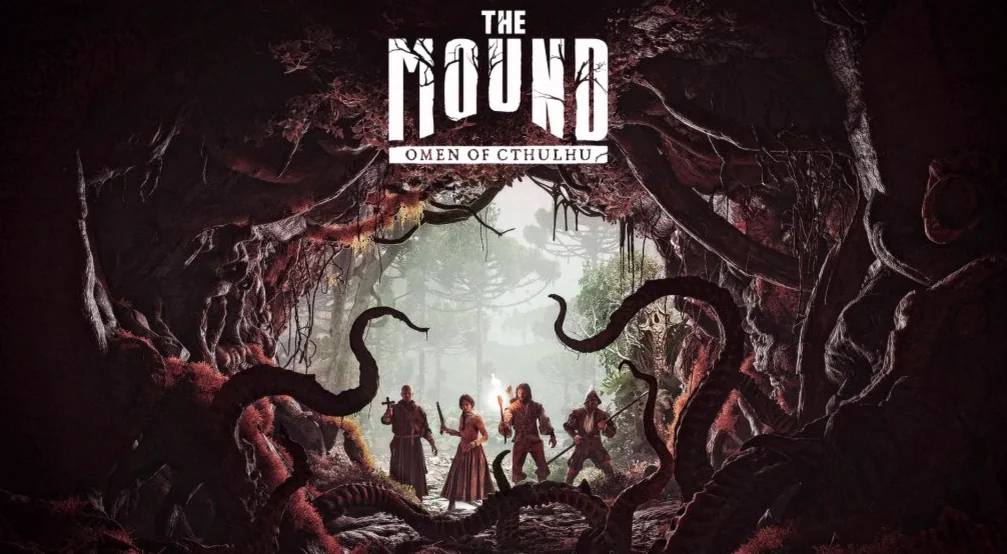
The Mound: Omen of Cthulhu puts players on a grim expedition to a mysterious island where earlier crews vanished without a trace—and stepping onto the land is enough to hint at what happened to them. The game leans hard into Lovecraftian dread, wrapping its survival-and-reward loop around religious dread, jungle soundscapes, and moments that can turn co-op chaos into something far worse.
Quick facts
- Premise: a contract ship crew travels from island to island to collect riches and mission-specific items.
- Lovecraft connection: the story draws thematic elements tied to a Lovecraft novel published long after it was written.
- Platforms tested: the PC-to-console adaptation was reviewed on Xbox Series S.
- Co-op: up to four players total (one host plus three others), with crossplay support.
- Session structure: each mission runs about 20 minutes and unfolds across 14 locations.
- Tech note: on Xbox Series S it ran smoothly, but the game crashed twice, returning to the start screen.
The adventure begins with a voyage aboard a ship called La tempestad, sending a small cast ashore to search for scattered valuables across the island. The cost is immediate: two previous expeditions disappeared completely, and as soon as the player sets foot on the ground, the game starts making it clear that something inhuman likely claimed those missing crews.
The title is presented as a co-op-friendly horror experience with deep Lovecraft DNA. It references the idea behind The Mound—a novel written in 1930 by American author H. P. Lovecraft but not published until 1989—though the game does not follow the original plot beat-for-beat. Instead, it uses Lovecraft-style elements openly for players who want to spot them.
The story can be approached initially with four characters: Don Rodrigo de Medina, Fray Gaspar, Leonor, and Alonso de la Torre. Each character has their own reason for exploring the forgotten territory, but the narrative’s main focus isn’t framed as a traditional story-driven experience.
Audio, immersion, and first-person horror
One of the game’s strongest points is its atmosphere-building sound design. The review highlights an “almost complete absence” of music—something that would normally be viewed as a negative—but argues it works because the sound effects sell the world: rain pounding, jungle ambience, breathing, and even gunshots are presented with careful polish that keeps players fully inside the experience.
Melodies do appear, but only in key moments and not in abundance. The review still praises their timing and execution, while emphasizing that the lack of constant scoring helps the gameplay-focused horror land.
Perspective is handled in first-person, which the review calls “very well done.” A shoulder or third-person option is mentioned as something that would have been welcome, though third-person does appear during certain specific events later in the experience.
Language support is also uneven. Text is localized to Spanish only in the Iberian variant, while all voice acting remains in English with a forced Spanish accent. Given the setting’s Spanish conquerors and the team’s Chilean background, the review argues a full Spanish (Iberian) dub would have been a better match.
Xbox performance and stability
Porting the PC version to Xbox is described as somewhat controversial: the game is said to feel like a PC title adapted to console rather than a native console experience. On Xbox Series S, performance was reported as stable with no stutters.
However, the review also reports two crashes during testing. Each time, the game closed without an error and dumped the player back to the start screen.
Loadouts, traversal, and what you can carry
Gameplay starts with signing a contract on La tempestad. After accepting a mission, players can choose equipment for the incursion, including weapons (revolvers, rifles, machetes, axes, knives, spears, bows, arrows, and other melee weapons) and defensive items like helmets and cuirass-style armor that make incoming hits more survivable.
Utility items round out the loadout: talismans to identify treasure faster, bandages and food for energy recovery, and crucifixes meant to protect against certain jungle terrors.
Inventory management is central. Every item occupies space, forcing players to plan routes and decide what they can bring back. The review notes that creativity is required to return safely to the ship because you can’t simply carry everything.
That planning is supported by a companion cart pulled by an ox that stays with the player throughout exploration. It allows storage while you search, and it also leaves a trail of salt that can be followed back to the boat when escape is urgent. The cart can be loaded with firewood to make campfires, and it can also carry hunted animals back to the ship.
Mission structure, escalating danger, and stealth windows
Each mission unfolds across 14 different locations, with varying difficulty and complexity. The review points out practical conditions that affect play, such as arriving at night (requiring torches for visibility) and rain preventing firearms use because gunpowder gets wet.
Beyond those details, there’s a clear gameplay rhythm: the location starts relatively calm for a few hours, then—after a time the player can check in the menu—the island “wakes up.” From there, the review describes it as constant pressure: the whole island pushes back and the horror becomes far more lethal.
Stealth is most useful early. Players are encouraged to avoid firearms, using quieter movement like cutting or breaking branches instead. Once the island wakes, the only priority becomes survival at any cost, with a red-bar energy meter marking the line between life and death. Bleeding effects are also shown to drain vitality quickly.
Original hallucinations—and rough combat feel
A standout mechanic involves hallucinations that appear on screen. These are audible only to the player experiencing them, even during co-op, and they can cause teammates to attack each other by mistaking hallucinated threats for real enemies. The review calls this idea “very original” and highlights the resulting emergent chaos as a strong point.
Combat, though, is judged less favorably. Melee hits are described as feeling strange and imprecise, and ranged attacks are said to be difficult to execute accurately.
Co-op rules, permanent death, and infected-state incidents
The game is built around online co-op, allowing play with up to three additional players via crossplay. It’s also possible to play with an effective AI partner. The review warns that when solo, permanent-death risk is higher because the “calvo” AI character sometimes arrives late.
When a player dies, the jungle “swallows” them and turns them into a zombie-like state. At that point the camera shifts to third-person, where the player character attacks teammates while the person who died can’t control anything. If teammates manage to regain control and rescue the infected player, the player gets another chance to live—though the review describes a subsequent vomiting sequence involving an “oruga” that must be crushed or that continues attacking.
Progression gaps and mission length
Each mission lasts about 20 minutes depending on the jungle’s mood and how much players explore. Online sessions are framed as the main long-form hook because the game is designed to be replayed while you learn the island’s dangers.
Progression has a frustrating limitation: collected mission objects can’t be reused later. The review notes that this makes some pickups feel pointless once the mission ends.
Weapons can be improved aboard La tempestad using tokens earned by completing missions. But improvements appear to be tied to a single mission—available only for that run, not carried forward—leading the review to treat the system as wasteful.
Scores and overall verdict
The review assigns scores of 70/100 for the technical section, 75/100 for gameplay, and 80/100 for duration. The conclusion is that the premise is compelling and the title is genuinely fun, especially when played with headphones and friends, but it still needs further polishing—particularly around console optimization.
Overall, The Mound: Omen of Cthulhu is presented as an original co-op horror experience with strong atmospheric potential and a few standout mechanics, but with enough rough edges—crashes on Xbox Series S, progression/purpose issues, and combat feel problems—that it still has room to improve before it fully lands.