Wisconsin Shop Finds 97 Sealed Super Mario Bros./Duck Hunt NES Copies for Auction
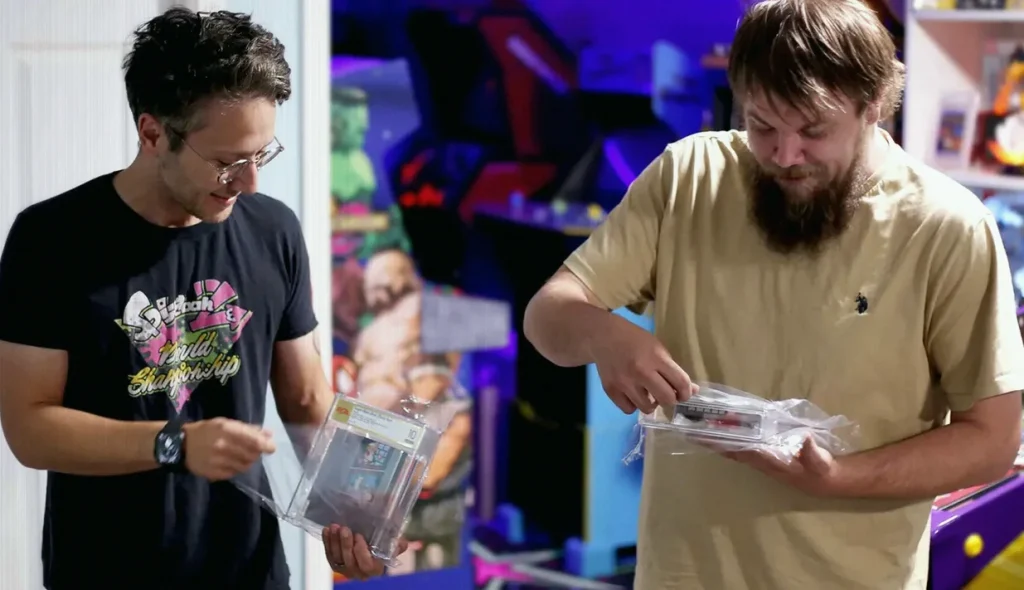
A Wisconsin vintage shop owner has uncovered an extraordinarily rare cache of unopened NES cartridges: 97 copies of Super Mario Bros. / Duck Hunt still sealed in their original retail-style packaging, featuring a bilingual back label and what PSA says is an unprecedented variant. The haul is now being graded, serialized, and prepared for a major auction this summer—after PSA authentication confirmed five perfect “10” scores among the set.
Announcement: a 1995-era NES box hiding 1993 cartridges
The discovery began when Jason Ganos, who runs the Nintendo-focused site NintendoWire, started helping collector Kevin Braun at Braun’s OneStopWonders store in Waukesha, Wisconsin. After initially working on pinball repairs, Braun asked Ganos to help sell older video game inventory stored away in his unit.
Among the items was a rectangular box of NES cartridges that had been in storage for six years. The box had multiple stickers with both English and Japanese text. One sticker indicated the shipment date of December 1, 1995, but another label identified the contents as 100 units of Super Mario Bros. / Duck Hunt for the NES.
When opened, the box contained 97 individually wrapped cartridges, each with a manual attached on the back. Ganos noted that Duck Hunt is typically remembered as a pack-in title bundled with the NES console—making the late-life-cycle shipment date feel unusual at the time.
Practical impact: PSA authentication and record-grade results
After Ganos shared photos with collectors, two grading-industry directors—one from a major grading organization and one from PSA Games—raised concerns that the cartridges might be fake or represent never-before-seen variants. They asked for extensive photos, including circuit boards and internal details.
PSA subsequently authenticated the entire set of 97 cartridges as legitimate. PSA reported that five of the cartridges received perfect 10 grades. The full PSA breakdown for the haul was 60 units graded 9.8, 31 units graded 9.6, five units graded 10, and one unit graded 9.4.
PSA also serialized the entire collection—an action the company says it has never done before—encapsulating each copy together with its manual.
PSA Head of Video Games Claire Shelton said the carts were “shocking,” describing the grading process and why near-perfect items are rare, especially given manufacturing inconsistencies common to injection-molded components. She also emphasized that the individually stored plastic baggies likely prevented dust-related wear, adding that without those bags, the set would not have achieved tens.
Platform scope: NES only, with a new variant manual and bilingual labels
The verified haul is for the NES and specifically the Super Mario Bros. / Duck Hunt cartridge set. PSA’s assessment highlights several distinguishing features:
- Unopened, newly sealed cartridges “straight from the manufacturer,” per PSA
- A variant where each cartridge’s manual is placed on the back
- A bilingual back label (English and Japanese)
- Internal motherboard and labeling details that do not match known copies, including different back label text, manual language, and different dates listed on the manual
Based on manual information, PSA indicated these cartridges were manufactured in late 1993—making them, in Ganos’s words, the latest prints of the game observed so far.
What comes next: Goldin auction window and estimated value
With authentication complete, the cartridges are heading to market. Three of the graded cartridges will be auctioned through Goldin Auctions on August 12. The auction is scheduled to run for three weeks, with a tentative end date of September 9.
Ganos said he would also like to auction one cartridge for charity, though he has not finalized any concrete plan.
On valuation, Shelton said she could not guarantee a precise figure, but suggested the set could land in the four- to five-figure range per cartridge. She indicated that four digits would be a floor, multiple thousands would be expected, and five digits were possible—while also noting she wouldn’t expect higher-than-five-digit outcomes.
For collectors, the key data point is that PSA graders will have made the “10” rate visible, which Shelton estimated at roughly 4% of the set—five perfect tens out of 97.